- Strategic Structuring
- Risk Mitigation
Capital Markets
- Digital Engagement
- Market Visibility
Public Perception
- Shareholders Services
- EDGAR Filings



The U.S. IPO market has reopened, but the SEC’s first-half figures reveal a market whose depth is still in question. Capital has clearly returned to the new-issue market, but it has not been distributed evenly. Capital is available for new listings. So far, it has flowed disproportionately to SPAC formations and a few unusually large offerings, while the number of operating companies completing IPOs has fallen. For a board weighing a launch, the question is less whether the market is “open” than whether its own deal can attract sufficient demand at a sensible valuation and perform well once trading begins.
The headline numbers look impressive. The SEC reported 208 IPOs raising more than $137 billion in the first half of 2026, up from 180 raising more than $27 billion a year earlier. Follow-on offerings also increased, another sign that capital is available in the public markets.
But the composition of IPO activity presents a more mixed picture. SPAC IPOs rose from 66 to 118, while corporate IPOs fell from 111 to 88. In the second quarter, the corporate deals that did reach the market were also much larger, with median proceeds rising to $279.5 million from $14.6 million a year earlier.
Taken together, the numbers suggest that the reopening has not been broad-based. More capital is being raised, but fewer operating companies are reaching the market, and the deals that do get done tend to be larger. For smaller and mid-sized issuers, that distinction matters: a stronger headline market does not necessarily mean easier access to public capital.
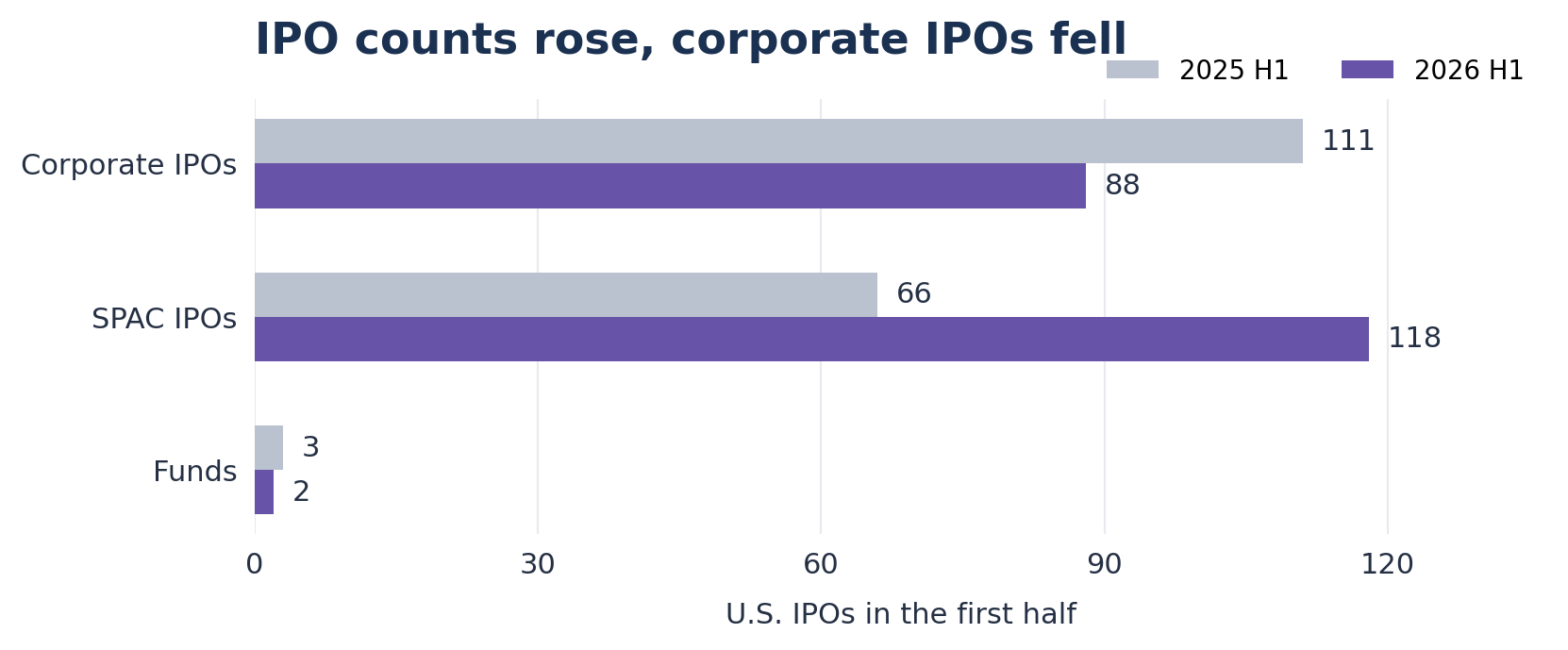

Figure 1. IPO counts by issuer type. Source: SEC DERA, first-half 2025 and 2026 data.
The concentration is even more visible in total proceeds. SpaceX’s $86.25 billion offering accounted for about 63% of DERA’s $137.9 billion first-half total. A deal of that size shows that investors are willing to commit significant capital to the right issuer, but it also makes the overall market look stronger than the experience of a typical IPO candidate may suggest.
For companies considering a listing, the more useful question is whether businesses with a similar size, sector and profile are actually pricing successfully and finding support in the market. Aggregate proceeds show that capital is available. Comparable deals show how accessible that capital really is.
Third-quarter activity has kept the IPO window open, but it has also reinforced how concentrated the recovery remains. Renaissance Capital counted 30 U.S. IPOs raising $32.8 billion during the quarter. One offering alone accounted for $26.5 billion, leaving just $6.2 billion across the rest of the market. The message is similar to the SEC’s first-half data: large transactions can lift headline proceeds quickly, but a broader reopening will require more companies to price successfully across different sizes and sectors.

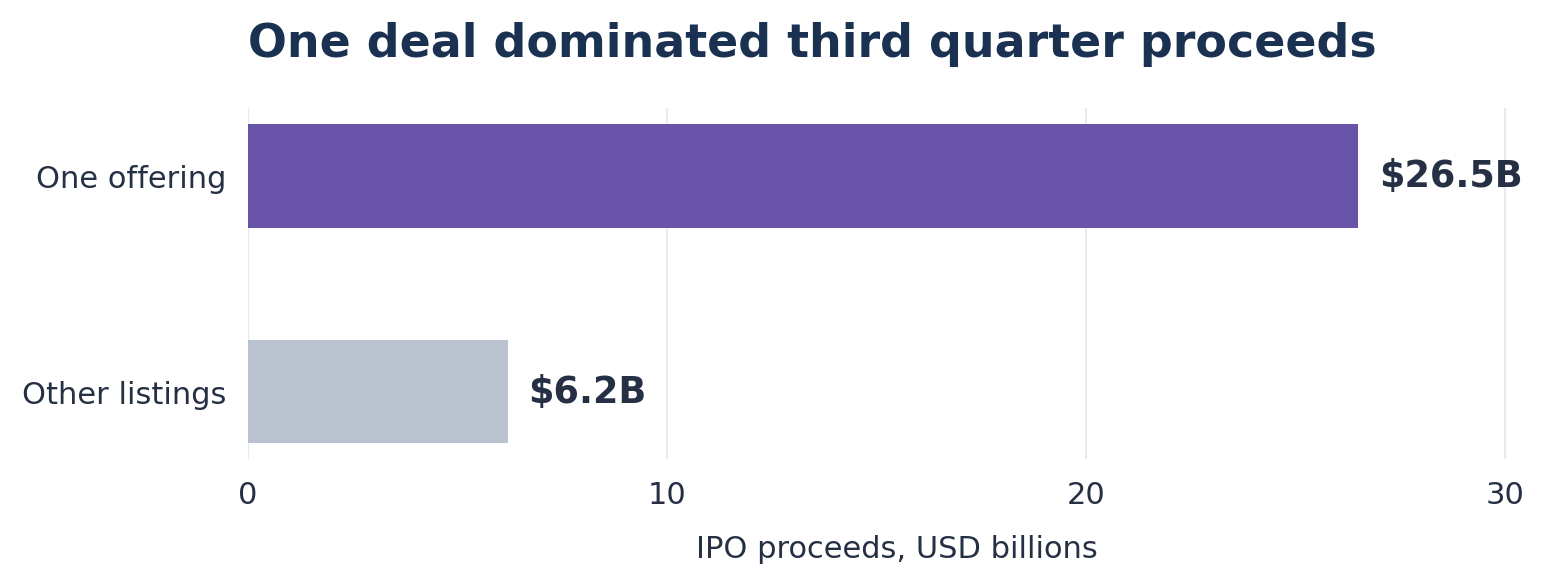
Figure 2. Renaissance Capital’s third-quarter proceeds: $26.5 billion from one offering and $6.2 billion excluding it. Its published figures are rounded independently.
The pipeline is active, but filing does not guarantee that a company will ultimately price. Oura amended its public S-1 in September before later postponing its IPO amid market uncertainty, while TFP Group filed an F-1 during the month. Oura’s decision is a useful reminder that even an advanced IPO can pause when valuation or broader market conditions no longer support the deal. For a board, timing therefore involves more than being ready to file. It also means deciding whether the capital raised at today’s price is worth the dilution and post-listing profile that comes with it.
Sector interest is also selective. Technology and industrial companies were among the larger traditional offerings in the first half, while biotech and AI infrastructure remained active themes in the third quarter. But sector momentum alone is not enough to carry a deal. Investors still need to see how the proceeds translate into operating progress, whether through revenue growth, additional capacity or a longer development runway. The quality of that investment case will ultimately matter more than the sector label itself.
The picture is even more uneven for foreign issuers. DERA counted 30 non-U.S. issuer IPOs in the first half, down from 76 a year earlier, even as U.S. issuer IPOs increased from 104 to 178. At the same time, median proceeds for non-U.S. offerings in the second quarter rose from $10.7 million to $100 million. In other words, fewer foreign companies reached the market, but those that did were generally coming with larger offerings. A large Asian listing can demonstrate investor appetite for a particular issuer, but it does not by itself signal a broad reopening for overseas companies.
For China-based issuers in particular, market conditions are only one part of the timing decision. Nasdaq’s $25 million gross-proceeds threshold for covered China-based companies and the separate CSRC filing process mean that deal size, regulatory preparation and market timing have to be considered together, especially for smaller issuers.
SPAC fundraising tells a similar story. DERA and S&P Global each counted 118 SPAC IPOs in the first half of 2026, showing that sponsor capital has returned to the market. But raising a SPAC is only the beginning of the process. Boardroom Alpha tracked 36 completed U.S. de-SPAC combinations year to date as of October 2, and targets still have to navigate redemptions, closing cash requirements and the transition to public-company reporting.
That distinction matters because the strength of the SPAC market cannot be measured by IPO formation alone. The more meaningful test is how many SPACs can turn that capital into completed combinations with sufficient cash at closing and a credible operating story once the combined company begins trading. The SEC’s 2024 SPAC rules also place greater attention on sponsor conflicts, dilution, projections and target-company financial disclosure throughout that process.
A selective IPO market puts a premium on preparation. When investor demand and valuation align, the usable window may not stay open for long. Companies that are still resolving accounting questions, disclosure gaps, or internal-control issues at that point may find themselves spending valuable time on work that could have been completed earlier.
The company's readiness for the public markets goes beyond the prospectus itself. It also requires governance, reporting, and shareholder processes that can function from day one. Board composition and committee responsibilities, public-company policies, EDGAR access, financial reporting, and transfer-agent coordination all become part of the same transition. The goal is not simply to complete the IPO, but to be ready for the reporting and governance responsibilities that begin immediately afterward.
D&O insurance is another part of that preparation. Securities litigation remains a meaningful part of the public-company risk environment: Cornerstone Research and Stanford recorded 121 securities class actions in the first half of 2026, up from 93 in the previous six months. The increase was not driven by a surge in IPO-specific Section 11 cases, but it still reflects the different liability environment a company enters once its shares begin trading. For an IPO candidate, coverage should be reviewed as part of the broader transition from private to public company, rather than left until the transaction is already approaching launch.
The broader lesson is that an open IPO market does not mean every issuer should rush to launch. In a market where capital is available but still selective, preparation gives a company more flexibility to move when valuation and investor demand are aligned, rather than forcing a transaction simply because the window appears open. A broader recovery will become clearer when companies across a wider range of sizes and sectors can consistently price and trade successfully after listing.
U.S. Securities and Exchange Commission, “SEC Publishes Updated Market Statistics, Highlighting Increase in IPOs and Proceeds Raised,” September 23, 2026. Source
SEC staff, “Initial Public Offerings (IPOs),” September 22, 2026. Source
Space Exploration Technologies Corp., Form 10-Q for June 30, 2026, filed August 2026. Source
Renaissance Capital, “Updated: Renaissance Capital’s 3Q 2026 US IPO Market Review,” October 1, 2026. Source
Stephen DePietto, S&P Global Market Intelligence, “Mega-Deals Push H1 2026 U.S. Equity Issuance into Orbit,” July 12, 2026. Source
Associated Press, “Smart ring maker Oura puts off initial public offering due to market uncertainty,” September 29, 2026. Source
SEC, “Order Granting Accelerated Approval of SR-NASDAQ-2025-069,” May 14, 2026. Source
China Securities Regulatory Commission, “CSRC Releases New Regulations for Filing-based Administration of Overseas Offering and Listing,” February 17, 2023. Source
Boardroom Alpha, “DeSPAC Tracker,” continuously updated, data as of October 2, 2026. Source
SEC, “Special Purpose Acquisition Companies, Shell Companies, and Projections: Small Entity Compliance Guide,” 2024. Source
Cornerstone Research and Stanford Law School Securities Class Action Clearinghouse, “Securities Class Action Filings: 2026 Midyear Assessment,” July 29, 2026. Source
 APAC Companies Seeking U.S. IPOs in H1 2026: Filing Activity Stayed Active, but Conversion Still Depends on Quality